
The Science Of Breathwork
WHAT IS ACTUALLY HAPPENING IN THE BODY
The science of Breathwork - How it Works
Breath is the foundation of life, linking body, mind & consciousness. The breath can affect the nervous system. The rhythm, depth & pattern of breathing determine whether the body is in a stress response or a state of rest, healing & expansion. Mouth breathing (especially rapid or erratic breathing) can cause hyperventilation & sympathetic nervous system activation (fight or flight mode). Nasal breathing (especially slow & deep) activates the parasympathetic nervous system (rest & digest mode). Conscious connected breathing through the nose keeps the body in an optimal state of balance, preventing excessive activation while still allowing for a deep emotional processing. This rhythm encourages full oxygen exchange & maintains Carbon Dioxide (CO₂) balance, preventing excessive vasoconstriction (blood vessel narrowing). Nasal breathing also activates the parasympathetic nervous system, keeping the body in a regulated state, promoting deep relaxation & emotional integration.The vagus nerve is a key part of the parasympathetic nervous system & connects the brainstem to the heart, lungs & digestive organs. Nasal breathing stimulates the vagus nerve promoting relaxation, emotional regulation & nervous system resilience. Longer exhales (without forcing) enhance vagal tone, helping the body process emotions, trauma & stored tension safely. You will be supported by being guided to keep your nasal breathing steady.The science of Breathwork - Symptoms in Breathwork
Many people assume that the urge to breathe is triggered by low oxygen, however, it is actually rising CO₂ levels that are the main driver of the breathing reflex. During a continuous, connected breathing pattern, as breathing becomes deeper & more continuous, Oxygen is inhaled & CO₂ is exhaled. If an individual was exercising CO₂ would be being produced by the body tissues & needing to be expelled. However, because a participant is lying down in Breathwork, not producing a large amount of CO₂ to be expelled, more CO₂ is being expelled than is being produced by the body tissues, which can temporarily lower CO₂ levels in the blood (the blood becomes temporarily more alkaline). This can change the body’s acid-base balance & can lead to the physical sensations commonly experienced during Breathwork including tingling & light-headedness. The low CO₂ in the blood can also increase the sensitivity/excitability of nerves & muscles, resulting in muscle tightness, or temporary involuntary muscle contractions (tetany). These sensations are related to changes in carbon dioxide (CO₂) levels rather than oxygen levels - which actually remain high because of increased intake of air.
In healthy individuals, oxygen saturation typically remains within the normal range throughout the session, even when these symptoms are present. Nasal breathing naturally helps regulate airflow & maintain higher levels of CO₂ more effectively than mouth breathing, often resulting in a gentler & more balanced Breathwork experience while still allowing access to the benefits of the practice.
All physical sensations experienced during a Breathwork session are closely monitored by your facilitator, & participants are encouraged to communicate any concerns or discomfort at any time throughout the session.The science of Breathwork - CO₂ & Cerebral Vasoconstriction
CO₂
CO₂ is often referred to as a waste product, which is true, however is also plays a crucial role in oxygen transport from the blood to the tissues. This is called the 'Bohr Effect' - Increased CO₂ levels helps oxygen leave haemoglobin. When CO₂ levels are balanced, oxygen is more effectively released from haemoglobin to the brain & tissues. When there is excessive mouth breathing or hyperventilation, CO₂ in the blood can decrease very low, & although oxygen levels in the blood remain normal (95-100%), oxygen is held more tightly by the haemoglobin, which makes it harder for oxygen to be delivered efficiently to the body’s tissues. Nasal passages are much more narrowed than the mouth opening, which naturally regulates airflow, making it harder to hyperventilate excessively with nasal breathing.VasoconstrictionCerebral vasoconstriction is the narrowing of blood vessels in the brain, reducing blood flow & oxygen delivery. This can occur naturally in response to stress, dehydration or rapid shifts in CO₂ levels. Chronic stress & trauma naturally induce vasoconstriction as part of the fight/flight response. Long term vasoconstriction can impact cognitive function, emotional processing & awareness. Conscious connected breathing helps interrupt this cycle by training the nervous system to regulate circulation & release tension. While Breathwork is known for increasing circulation (vasodilation), intense breathing patterns - especially over-breathing (breathing too fast or too deep - even through the nose), can trigger vasoconstriction.The body uses CO₂ as a signal for how much blood flow is needed. When CO₂ levels are normal, blood vessels stay relatively relaxed and open so blood flows normally to the brain. High CO₂ indicates that the tissues & cells are working hard & producing lots of metabolic waste, which results in increased blood flow to the tissues. Low CO₂ indicates that issues appear to need less blood flow so the body decreases blood flow to the tissues by constricting the vessels. Hyperventilation during Breathwork causes the body to interpret the unusually low CO₂ as a signal that less blood flow is required, so the blood vessels constrict. This can cause experiences of dizziness, visual changes such as tunnel vision, or a feeling of emotional detachment. This is one reason why hyperventilation can make someone feel faint even though they have plenty of oxygen in their blood. If this occurs, the individual will be guided to slow their breathing & extend the exhale. A prolonged exhale naturally increases CO₂ retention, helping restore cerebral blood flow & balance oxygen delivery. Nose breathing helps regulate CO₂ more effectively than mouth breathing, preventing excessive CO₂ loss that can lead to this potential vasoconstriction, supporting steady oxygen delivery & brain function. The participant will also be encouraged to shake the arms & legs which will also increase production of CO₂ in the tissues, helping to rebalance the Co2 in the blood. Increased breathing —> CO₂ expelled faster than it is produced —> Low CO₂ —> Body thinks cells/tissues don’t need ventilating —> Vasoconstriction —> Decreased oxygen delivery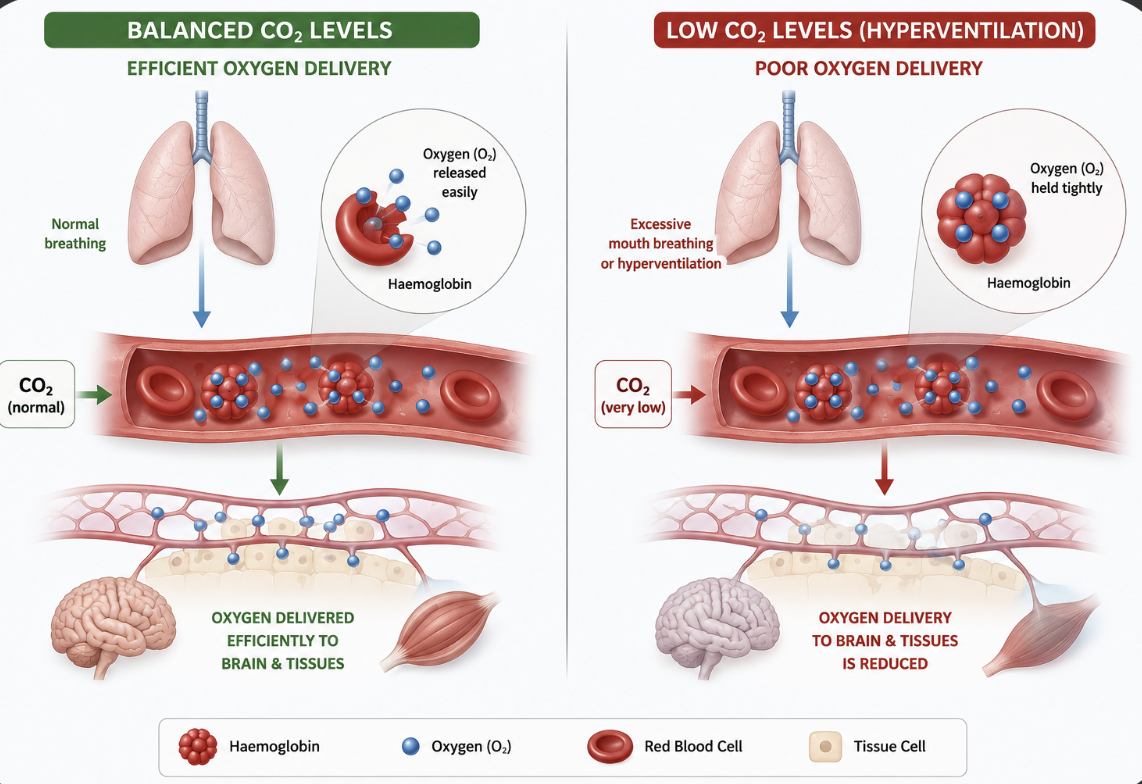
The science of Breathwork - Nasal Breathing & Nitric Oxide
Nitric oxide (NO) is a gas produced throughout the body which acts as a signalling molecule that helps regulate blood vessel dilation, blood flow & oxygen delivery. The paranasal sinuses (air-filled spaces around the nose) continuously produce NO. During nasal breathing, air passes through the nasal passages & sinuses, NO mixes with the inhaled air, which is then carried to the blood stream via the lungs. Mouth breathing bypasses this process resulting in much less NO reaching the lungs. Higher NO levels contribute to improved circulation & brain function, deep nervous system relaxation & enhanced neuroplasticity & emotional integration.The science of Breathwork - Rebound Vasodilation
Cerebral vasodilation is a powerful physiological process in Breathwork that enhances oxygenation, brain function & emotional healing. During Breathwork, moments of deep breathing may initially lower CO₂ (hypocapnia) causing temporary vasoconstriction. However as the body recalibrates, CO₂ levels stabilise again, leading to rebound vasodilation - a surge of fresh, oxygen-rich blood flows to the brain. This often brings deep relaxation, emotional release & processing, expanded awareness or mental clarity.
Increased cerebral flow during Breathwork also shifts brainwave activity towards Theta & Gamma states, frequencies associated with deep meditation, intuitive insight & emotional breakthroughs. This may explain the psychedelic-like experiences some people have during Breathwork, where suppressed memories, emotions & expansive realisations surface.
This explains several reason why breathing through the nose rather than the mouth is encouraged in this technique, as it naturally helps regulate breathing which maintains higher levels of CO₂ & O₂ in the blood - both essential for efficient oxygen delivery & blood vessel dilation. Nasal breathing also supports a calmer, more balanced nervous system.
Breath is not just a physiological function - it is an energetic bridge to deeper awareness, emotional release & spiritual transformation. By balancing physiology, CO₂ regulation & energy flow, a Breathwork journey can be guided in a way that is both powerful & grounding.